The expected number of celestial bodies that will impact this planet in 10 years is the integral of the product of the possible direction along with the probability density function; in essence the sum of the total objects over all possible directions. If the answer is more than one, we will have less chance of survival. We want the probability to be low because we are adding for infinitely possible directions. Then again, catastrophe theory may be fear mongering or a public anxiolytic.
Wednesday, September 13, 2017

Tuesday, August 1, 2017
Factor product of two large distinct primes....BY HAND... A challenge!
What is the best way to determine if 91042014201224789 is prime?
Now suppose you are stuck on an island with nothing but a slide rule, any one specific table of your choosing, and an abacus, what is the best way to "by hand" determine if 91042014201224789 is prime?
SPOILER ALERT:
91042014201224789 is a product of two primes, both of which are upwards of 1.6 Million.
If you were stuck on a deserted island with aforementioned tools, how would you best go about factoring 91042014201224789? The naive, yet easy to implement on a computer/abacus/etc., way is to literally check the remainder when you divide 91042014201224789 by 2, then 3, then 4, then 5, ad infinitum, and see if you can hunt down the smallest factor of 91042014201224789.
As it turns out, if we were to attempt to divide 91042014201224789 by 2, 3, 4, etc., to check for even divisibility (i.e., no remainder), we would have to check every number less than (???).
Or, the TL;DR version: factor 91042014201224789 by hand or prove it is prime.
Now suppose you are stuck on an island with nothing but a slide rule, any one specific table of your choosing, and an abacus, what is the best way to "by hand" determine if 91042014201224789 is prime?
SPOILER ALERT:
91042014201224789 is a product of two primes, both of which are upwards of 1.6 Million.
If you were stuck on a deserted island with aforementioned tools, how would you best go about factoring 91042014201224789? The naive, yet easy to implement on a computer/abacus/etc., way is to literally check the remainder when you divide 91042014201224789 by 2, then 3, then 4, then 5, ad infinitum, and see if you can hunt down the smallest factor of 91042014201224789.
As it turns out, if we were to attempt to divide 91042014201224789 by 2, 3, 4, etc., to check for even divisibility (i.e., no remainder), we would have to check every number less than (???).
Or, the TL;DR version: factor 91042014201224789 by hand or prove it is prime.
Thursday, June 22, 2017
A number's perspective
A number's perspective, inspired by Edwin A. Abbott's book called Flatland.
There are some really famous constants that are irrational: pi, the square root of two, the golden ratio which is somewhat close to the ratio 16:9, and maybe even Euler's constant e.
You've probably already have heard about binary numbers or hexadecimal numbers. The most common numbers used in this world by humans are base ten, presumably for obvious reasons related to human anatomy.
Binary numbers are numbers built from powers of two like how base ten (decimal) numbers are built from powers of ten. They are traditionally written with two symbols such as zero and one. In base ten, a number represented as 1142 means 2 units, 4 tens, 1 hundred, and one thousand, all added together. Especially if you've ever dealt with scientific notation, we see that thousands, hundreds, tens, and units (ones) are all powers of ten: a thousand is ten to the third power, a hundred is ten to the second power, ten is ten to the first power, and one is ten to the zero power.
The overall pattern remains the same in other bases. When you see something like 1011 and if we want to convert binary to base ten, we must first recall two to various powers:
2^0, two to the zero power, is one, 2^1=2, 2^2=4, 2^3=8.
1011 = 1 + 1 x 2^1 + 0 x 2^2 + 1 x 2^3 = 1+2+0+8 = 11 in base ten.
For example, if we were talking about any base z, the meaning is still implied:
(abcd) in base z would be d + c x z^1 + b x z^2 + a x z^3.
What about having other types of numbers as bases? Some numbers are called rational and others irrational. The Greeks might have thought a number that repeats a sequence ad infinitum (or, in simpler cases a number whose digits terminate entirely) is more rational than a number whose decimal expansion involves a tail in which no set sequence of digits repeat, i.e., an irrational number.
There is one fact I want to focus on. If we are not told what the base is, it is pointed to by the representation 10. This is so because of the expression mentioned earlier. In the instance of 10, we have 10 = 0 + 1 x z^1 which simplifies to the desired formula for the base z, namely 10 = z which may look nicer if we say z = 10. In base ten, lo and behold that 10 is the representation, base ten, of ten. But it is also true in binary. 10 in binary means 0 + 1 x 2^1 which simplifies to 10 = 2 and 2 is the base in binary.
Let's say a few words about base pi. In accordance with the above paragraph, in base pi, 10 = pi. In base ten, 3.14 approximates pi but since pi is irrational, in base ten, it's digits will never repeat a set sequence, i.e., it's expansion in base ten is not repeating, in contrast to the rational number 1/3, which involves repeating 3 "forever."
If irrationality means "has no repeating sequence of digits," what about pi's representation in base pi? In base pi, pi is represented by 10 as we saw earlier.
What's so special about this? Well, 10(base pi) is a terminating representation. Numbers with terminating representation are called rational.
Pi is irrational in base ten and it is rational in base pi.
So there must be something other that what I've stated that truly characterizes what the difference between a rational and an irrational number is.
Integer sequences and the OEIS
It is common for integer sequences to appear on intelligence tests. What is the next number? By polynomial interpolation, every finite sequence of integers has many fitting polynomials each of which squirts out a different "next" number. In addition, integer sequences in which at least one number is repeated infinitely often cannot be compressed into a polynomial because nonconstant polynomials aren't wiggly enough to repeat infinitely often.
Use of number sequences to provide evidence for intelligence is inherently dubious. Every finite sequence of integers has infinitely many formulas (no one correct/distinguished formula) which fit all the data and most infinite sequences are incompressible (the futility of compressing the incompressible).
Finding a formula for the nth term of an integer sequence has become a hobby of mine. Here is one example of the types of ideas that pop up: the Fibonacci sequence. What is the one billionth number? The follow your nose method would be to calculate the sum of the previous two terms approximately one billion times. Another method involves the golden ratio and eliminates the need to compute about a billion intermediate calculations. Setting parameters phi to be the golden ratio and psi we shall set to the negative reciprocal of phi, we know the following:
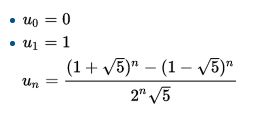 At first this formula for the Fibonacci sequence may look unduly complex for something as easy as adding the two previous numbers. However, this formula is perfect for the question, "what is the next number." There is one step to calculating the billionth term of Fibonacci: substitute one billion for n in the above equation. It almost feels like magic when all the square roots vanish leaving an integer. Though it is easier to just add two previous numbers, without a formula like the above one would have to calculate all terms of the sequence to answer the question "what is the billionth number".
My take on dimensions, numbers, and general relativity
Sounds like basically the four dimensions used in GR are all mathematically pretty much the same on a fundamental level. It's not like the fourth dimension of the model space in GR (which is R^4) acts much different from the first three. The metric that gives distance between two points in space-time, however, does do something different for the fourth dimension than it does for the first three. The square of distance infinitesimal element ds^2 is, by the transfer principle of logic, in addition to Pythagoras' theorem, is not merely
dx^2 + dy^2 + dz^2 + dt^2
I think that it's dx^2 + dy^2 + dz^2 - k * dt^2
for some value of k (I have no idea what k means physically). However, it didn't have to be the fourth one we write with a -k in front; it could have been the first one or the third one. What's necessary is that exactly three of the dimensions have positive metric but exactly one of the four must be multiplied by some negative number.
I don't think that GR is able to answer the question why 3 must have positive sign and 1 must have negative sign.
So, in that small technical sense of how points' distances between each other, the time dimension is only distinguishable as something who contributes negatively to distance squared. And if you remember your complex analysis, supposing there is more timelike distance than spacelike distance between two points, that means the distance itself will be a non-real, complex number.
The distance for two points only differing in the first three coordinates is never non-real. If the two points are the same point in 3-space, but if they aren't the same then they differ in the time-coordinate; in that case, the distance between them is imaginary. This tells us that the concept of measure/distance is dependent upon a sense in which space and time do not work the same exact way, the way, say, dimension 2 and dimension 1 work.
But let me say a word on that foul word, imaginary. Imaginary numbers get a bad rap. First of all, imaginary is a word describing contrast with what are known as real numbers. The real numbers are visualized and thought of as a line, well, points on a line. ALL imaginary numbers are are the numbers that are visualized and thought of as points in a PLANE.
Once you define how to add, subtract, divide, and multiply two complex numbers (i.e., basically imaginary numbers), the plane becomes a field just like the real numbers are. The complex numbers just have one more dimension than the real numbers; then not surprisingly, the complex numbers are specified by two coordinates.
I think complex numbers get a bad rap because of their unfortunate appellation. We owe the quirky, psychological descriptors labels for types of numbers to the Greeks. These numbers have colorful descriptions like irrational, transcendental, real, imaginary, negative, etc, etc.. The way the story was told to me it seems the Greeks basically couldn't fathom irrational numbers as ever possibly "actually" existing. The first way to need irrational numbers is when trying to deduce width and length from area. If a square can have 4 units of area and a 3-square can have 9 units of area, then why can't there be a square having 5 units of area? This needs the square root of 5 to be invoked.
At any rate, the complex numbers are essentially not a whole lot different from irrational numbers in a sense. Note that these numbers can solve the area problem when the area is negative the same way irrational numbers can solve the area problem when the area is not a perfect square number.
Oh yeah, perfect, that is another heavily-human word.
Thursday, August 11, 2016
Sunday, July 3, 2016
The disagreement with Max Tegmark
Max Tegmark is my favorite living scientist. I think that's a sign that you are a scientist or a musician or artist or poet: when you have a favorite one of that discipline.
(Not only if you get published, sell a record, or discover something new.)
He and I are at odds in one critical intersection of musings. He thinks reality must be "computable" and that only Godelian-complete "space" is allowed to be part of reality. He said straight up: Brian but formal languages are not mathematical objects.

Technically he said that Formal Systems aren't mathematical objects. That must be why he has it circumscribed by a red annulus.
Two things. Mathematical democracy and simpler theory compared to one in which only parallels which exist who meet certain strict criteria.
Formal systems, special cases of formal language, have the same ontological primacy as sets, strings, Neptune, and the HyperWebster which may be the context of any TOE. That means the hyperwebster is self similar and recursive (fractal).
The theory of formal languages indicates that formal language theory provides a type of model for classical set theory (i.e., ZF set theory). Thus sets are contingent upon them (and vice versa) for their existence.
So if Tegmark believes in a level 4 universe where mathematical structures are parallels equipped by the rules of the structure (in essence), that mathematical existence equals physical existence, then there are more general structures than the ones in set theory which represent parallels larger than he considers to exist.
Yet parallel UNIVERSES should be as all-inclusive as possible, and that's not to mention mathematical democracy, that all structures exist. Show the rules of formal languages to most mathematicians and I bet they would say it's no more or less a structure than groups... And if that caliber of peoples and organizations thinks formal systems (such as investigated by well known logician Raymond Smullyan) are mathematical objects.
For what it's worth, I think formal languages (hence, formal systems; the basis for his map of structure) are mathematical objects. This is not to mention that this way it obeys Occam's razor: the two theories have intersecting conclusions (reality is a mathematical structure), but mine doesn't arbitrarily discriminate as to whether they are "computable" which is rather anthrocentric.
So we have that (1) Formal languages are mathematical objects and (2) formal languages are more general than "computable structures." Computable structures would be a type of parallel but not a parallel universe. Give it a fancy name like quasi-parallel universe or quasi-parallel. Since formal languages encompass computable structures, they are more towards the Universe.
(Not only if you get published, sell a record, or discover something new.)
He and I are at odds in one critical intersection of musings. He thinks reality must be "computable" and that only Godelian-complete "space" is allowed to be part of reality. He said straight up: Brian but formal languages are not mathematical objects.

Technically he said that Formal Systems aren't mathematical objects. That must be why he has it circumscribed by a red annulus.
Two things. Mathematical democracy and simpler theory compared to one in which only parallels which exist who meet certain strict criteria.
Formal systems, special cases of formal language, have the same ontological primacy as sets, strings, Neptune, and the HyperWebster which may be the context of any TOE. That means the hyperwebster is self similar and recursive (fractal).
The theory of formal languages indicates that formal language theory provides a type of model for classical set theory (i.e., ZF set theory). Thus sets are contingent upon them (and vice versa) for their existence.
So if Tegmark believes in a level 4 universe where mathematical structures are parallels equipped by the rules of the structure (in essence), that mathematical existence equals physical existence, then there are more general structures than the ones in set theory which represent parallels larger than he considers to exist.
Yet parallel UNIVERSES should be as all-inclusive as possible, and that's not to mention mathematical democracy, that all structures exist. Show the rules of formal languages to most mathematicians and I bet they would say it's no more or less a structure than groups... And if that caliber of peoples and organizations thinks formal systems (such as investigated by well known logician Raymond Smullyan) are mathematical objects.
For what it's worth, I think formal languages (hence, formal systems; the basis for his map of structure) are mathematical objects. This is not to mention that this way it obeys Occam's razor: the two theories have intersecting conclusions (reality is a mathematical structure), but mine doesn't arbitrarily discriminate as to whether they are "computable" which is rather anthrocentric.
So we have that (1) Formal languages are mathematical objects and (2) formal languages are more general than "computable structures." Computable structures would be a type of parallel but not a parallel universe. Give it a fancy name like quasi-parallel universe or quasi-parallel. Since formal languages encompass computable structures, they are more towards the Universe.
Tuesday, May 31, 2016
Compression, Randomness, a theory of everything, and a 200TB proof
If the universe is describable (and I think it is if we allow neologisms), will its description fit in 1,000 pages? There is a computer that in two days apparently churned out a 200 TB proof yet my assumption is that the code is probably less than one GB. 200000GB to 1 GB is a mighty high compression ratio. Lossless compression at that. That 200 TB proof contains enough structure to be a proof. One could call the code that produced it a description of the proof.
In fact, 200,000:1 is exceptional levels of structure.
I tried using winRAR to compress various types of things. I attempted to compress white noise, speech, and a perfect 440Hz. I also compressed the output of a random number generator, plainext, and ciphertext. Finally images.
None of them is as high a compression ratio 200000:1 but that pales in comparison to infinite compression:
A sequence of all ones.
That description is a lossless compression of an infinite string to a finite string. So infinite to finite compression is attainable.
The question is will we ever find it?
Imagine the totality of all descriptions. This is included in the so called hyperwebster. Since the universe is describable, the hyperwebster contains that description.
Is that close?
In fact, 200,000:1 is exceptional levels of structure.
I tried using winRAR to compress various types of things. I attempted to compress white noise, speech, and a perfect 440Hz. I also compressed the output of a random number generator, plainext, and ciphertext. Finally images.
None of them is as high a compression ratio 200000:1 but that pales in comparison to infinite compression:
A sequence of all ones.
That description is a lossless compression of an infinite string to a finite string. So infinite to finite compression is attainable.
The question is will we ever find it?
Imagine the totality of all descriptions. This is included in the so called hyperwebster. Since the universe is describable, the hyperwebster contains that description.
Is that close?
Friday, May 20, 2016
Free Will, Omniscience, whether God plays dice, and a Theory of Everything
I'm having trouble accepting that random phenomena occur in the material universe but even less willing to accept that I don't have free will. If truly random phenomena occur, that would imply that determinism is false. Laplace had an idea called Laplace's demon which if feed the demon all the info about all the matter and energy in the material universe it will be able to use physics (or something) to predict what the state of the universe will be. It seems that if there can be Laplace's demon (which remains to be seen), that would imply determinism, no free-will, and the non-existence of truly random phenomena. If we assume that either determinism is false, or we do have free will, or truly random phenomena exist, then Laplace's demon does not exist.
Laplace's demon would seem to be equivalent to an omniscient agent of some kind. Basically the formulas in the TOE can predict the future and recall the past if fed absolutely every iota of information about the initial state of material such as every quark's momentum and position. In a sense, the TOE itself is the omniscient agent. It's just that the omniscience is not revealed until that TOE is programmed into a computer.
So, omniscience exists if and only if Laplace's demon (or something like it) exists. Also, if we take the stance that we have free will then that strikes down the possibility of Laplace's demon, meaning that the existence of an omniscent being would mean we have no free will.
And if we do have free will, that would suggest that there are no omniscient beings.
But maybe the universe is closer to a poem than a physics textbook (like a textbook from the future containing a TOE). Maybe this dance we play with symbols and truth tables with a T and an F, depending on the truth values of the two propositional variable, has no inherent bearing on truth (what is actually true). Maybe there is no such thing as simply black and white, false and true, maybe there is just relative grammatical correctness.
If the material universe is made of vibrating strings which exist not in the usual 3+1 dimensional space-time, then the set of states of the material universe is like a symphony. But a symphony has sheet music and whether or not that sheet music has been written down yet, it might still exist. This sheet music would be a TOE.
So we have a couple of options:
A. Laplace's Demon exists (or can exist)
B. There exists an omniscient agent
C. Determinism
D. Randomness does not exist
E. There is a TOE
OR
1. Laplace's Demon cannot exist (at least in the material universe)
2. Omniscience is impossible (though there may be a "maximally-scient" agent)
3. Non-determinism
3. God does play dice
4. There is no TOE
A scientist at NASA named David Wolpert seems to have proved that Laplace's Demon cannot exist. He used purely mathematical arguments; there was no reference or appeals made to quantum mechanics. I forget the details but something about having two omniscient agents try to emulate each other (i.e., copy what the other knows) and that leading to some kind of contradiction.
But argument by contradiction is not tautological in many-valued logics.
Laplace's demon would seem to be equivalent to an omniscient agent of some kind. Basically the formulas in the TOE can predict the future and recall the past if fed absolutely every iota of information about the initial state of material such as every quark's momentum and position. In a sense, the TOE itself is the omniscient agent. It's just that the omniscience is not revealed until that TOE is programmed into a computer.
So, omniscience exists if and only if Laplace's demon (or something like it) exists. Also, if we take the stance that we have free will then that strikes down the possibility of Laplace's demon, meaning that the existence of an omniscent being would mean we have no free will.
And if we do have free will, that would suggest that there are no omniscient beings.
But maybe the universe is closer to a poem than a physics textbook (like a textbook from the future containing a TOE). Maybe this dance we play with symbols and truth tables with a T and an F, depending on the truth values of the two propositional variable, has no inherent bearing on truth (what is actually true). Maybe there is no such thing as simply black and white, false and true, maybe there is just relative grammatical correctness.
If the material universe is made of vibrating strings which exist not in the usual 3+1 dimensional space-time, then the set of states of the material universe is like a symphony. But a symphony has sheet music and whether or not that sheet music has been written down yet, it might still exist. This sheet music would be a TOE.
So we have a couple of options:
A. Laplace's Demon exists (or can exist)
B. There exists an omniscient agent
C. Determinism
D. Randomness does not exist
E. There is a TOE
OR
1. Laplace's Demon cannot exist (at least in the material universe)
2. Omniscience is impossible (though there may be a "maximally-scient" agent)
3. Non-determinism
3. God does play dice
4. There is no TOE
A scientist at NASA named David Wolpert seems to have proved that Laplace's Demon cannot exist. He used purely mathematical arguments; there was no reference or appeals made to quantum mechanics. I forget the details but something about having two omniscient agents try to emulate each other (i.e., copy what the other knows) and that leading to some kind of contradiction.
But argument by contradiction is not tautological in many-valued logics.
Monday, February 1, 2016
Incompleteness
Some curious results surrounding consistency and inconsistency.
A system is called inconsistent if it proves a statement is true while also proving the negation of that statement is also true.
A system is called consistent if it is not inconsistent.
result #1: in an inconsistent system, every statement formulated in that system is both provable (thus considered true) while its negation is also provable (thus considered false).
In an inconsistent system, every statement is both true and false, and provably so. Thus inconsistent systems are viewed as kind of useless.
result #2: Russell proved in 1901 that what was current set theory in his time, the basis for most math, was inconsistent. Thus set theory in Russell's time was rendered useless because the statement like 2+2=Pi is both provable and 2+2 doesn't equal Pi is also provable.
So set theory was revamped in such a way that Russell's result and all other known problems with naive set theory (as it is now called) were avoided. The hope was that set theory would be consistent and that its consistency would be provable. Also, the hope was that set theory would be complete: every true statement was provable.
Gödel came along and proved something that was considered shocking at the time:
result #3: if a system can both express arithmetic and is consistent, then it is incomplete. Incomplete means there is a statement in that system which is both true but not provable.
That's kinda crazy sounding: a system like set theory should be able to express arithmetic. And it can. Now if a system is also assumed consistent (and remember inconsistent systems are "useless"), then there is a statement in that system which is both true and not provable.
Said differently, any system in which all statements in that system which are true are also provable and which can express arithmetic are also inconsistent. This was considered to be a shocking result.
Gödel did so in 1931 by concocting/discovering a way to formalize the statement "This statement is not provable."
For ease/indolence, let S be the statement that says "S is not provable."
Again in bivalent logic, there are two possibilities:
S is true or
the negation of S is true.
Option 1: S is true. Then S is not provable.
Option 2: S is false. Then S is provable. We define every statement which is provable to be true (in that system).
Option 2 is ruled out because we assume the system is consistent in Gödel's theorem. Since the system is assumed to be consistent, it is never the case that a statement and its negation are both true. In option 2, we proved that S is false and true which would make the system inconsistent.
Therefore, option 1 must be the case. IOW, there is a statement (namely S) which is both true and not provable.
Loosely speaking, a system is called incomplete if there is a statement in that system that is both true and not provable. This concludes the sketch of the proof that if a system can express arithmetic and is consistent, then it is incomplete.
If you're working on a problem involving trying to prove something, you might be faced with the possibility that that something is true (which is good in a sense) yet cannot be proved (no matter how much time you have or how clever you are).
This is bad. You might have picked a statement which is true but you will never be able to prove it!
Now the statement S which says "S is not provable" might seem like a trick to push through this argument but several examples of more interesting statements like the "halting problem" are neither provable nor disprovable. Such statements are called formally undecidable.
Incidentally, the existence of a statement S = "S is not provable" is called a self-referencing statement. This is basically where arithmetic is used and needed in the hypothesis of Gödel's incompleteness result: one needs arithmetic in what's now called Gödel numbering in order for S to exist and be a statement.
Also, there are different versions of incompleteness in many-valued logics (ones that "extend" classical logic to more than two truth values) but I am not super familiar with the interaction of incompleteness and many-valued logic. It has been extensively studied; I can say that much.
Friday, September 25, 2015
The Rule of all Rules
Basically about how "math class" can be different in different parallels. One ordinarily thinks that there can only one math class and that's probably true. But, there is a sort of uber math class which completely describes all other math classes as well as itself.
What I mean by "math class" is that, for example, in our system, the one we very much feel we are in right now, math class reveals that 2+1=3. The question is, do math classes in parallels have to be the same as our math class? What is the rationale for thinking "yes"? Thinking the answer is "yes" is precisely like imagining a geocentric universe. It's logic-centric. A logic described by human logicians with their own swing on things. What if human logic is not universal; what if in some parallels, 2+1 is not =3?
The uber math class is the same for all parallels, I think, but in this grand system there are uncountably many systems embedded within. (Parallel = System.)
I realized that some interesting things happen when analyzing the statement S which stands for "All rules have exceptions." As it turns out, from just analyzing S, we can conclude that the rules of a system are not more than sets of true statements about that system. Also, S is NOT in itself a rule.
I wonder if other phrases in English sound very much like rules but, technically, are not rules.
Is my (possibly obscured) definition of "rule" even close to appropriate? I mean, nothing's wrong with a definition but maybe what I have said has nothing to do with actual rules.
The truth of a system is relative. No system need work like any other system. All rules have exceptions. I don't think we can avoid semantics for very much longer.
Thursday, May 28, 2015
As a background, these are what are known as formal systems:
http://en.wikipedia.org/wiki/Formal_system
In Max Tegmark's TOE gif, he cites formal systems as being the basis for all of math, including set theory and first order logic. You see the circle down there at the bottom:
I believe that within my development of grammatical systems, which are more general than formal systems, I found a way to prove that something is true of all theorems within a formal system. Could this hint at the nature of truth if we consider theorems to be, in any sense, true?
This is still in the preliminary stages but I think that if we can prove the following about a property P then property P must be true of all theorems in a formal system:
1. P holds for all axioms in the formal system
2. If P is "closed under all inference rules"
then
P holds for all theorems.
To unpack (2) a bit, it's a little complicated. A very specific example of an inference rule, one used in first order logic, is modus ponens. Modus ponens is a binary inference rule, meaning it has two inputs. Very simply, inference rules are functions that input n inputs, with n at least one, and output a single statement, called the conclusion of the inference rule. Modus ponens for instance takes two statements of the form
(a) Statement A
(b) IF A THEN B
and modus ponens outputs
B.
Basically modus ponens is saying that if A is true and if "IF A THEN B" is true, then one can conclude "B".
So for P to be closed under all inference rules in a formal system means that if R is any n-ary inference rule and P is true of all theorems T1, .., Tn, then P is also true of R applied to the n-tuple (T1,...,Tn).
IOW, If P is true of every term in the n-tuple (T1,...,Tn) and if P is true for R(T1,...,Tn) then we say that P is closed under all inference rules.
Again, if we can show that P is true for all axioms and if P is closed under all inference rules, then P is true for all theorems (i.e., true statements) within a formal system.
I am still working on giving some interesting examples of this phenomena.
http://en.wikipedia.org/wiki/Formal_system
In Max Tegmark's TOE gif, he cites formal systems as being the basis for all of math, including set theory and first order logic. You see the circle down there at the bottom:
I believe that within my development of grammatical systems, which are more general than formal systems, I found a way to prove that something is true of all theorems within a formal system. Could this hint at the nature of truth if we consider theorems to be, in any sense, true?
This is still in the preliminary stages but I think that if we can prove the following about a property P then property P must be true of all theorems in a formal system:
1. P holds for all axioms in the formal system
2. If P is "closed under all inference rules"
then
P holds for all theorems.
To unpack (2) a bit, it's a little complicated. A very specific example of an inference rule, one used in first order logic, is modus ponens. Modus ponens is a binary inference rule, meaning it has two inputs. Very simply, inference rules are functions that input n inputs, with n at least one, and output a single statement, called the conclusion of the inference rule. Modus ponens for instance takes two statements of the form
(a) Statement A
(b) IF A THEN B
and modus ponens outputs
B.
Basically modus ponens is saying that if A is true and if "IF A THEN B" is true, then one can conclude "B".
So for P to be closed under all inference rules in a formal system means that if R is any n-ary inference rule and P is true of all theorems T1, .., Tn, then P is also true of R applied to the n-tuple (T1,...,Tn).
IOW, If P is true of every term in the n-tuple (T1,...,Tn) and if P is true for R(T1,...,Tn) then we say that P is closed under all inference rules.
Again, if we can show that P is true for all axioms and if P is closed under all inference rules, then P is true for all theorems (i.e., true statements) within a formal system.
I am still working on giving some interesting examples of this phenomena.
Sunday, May 24, 2015

Wednesday, April 29, 2015
An ontological feedback loop. Interesting!
Every ring is a group so groups are more general than rings.
Every group is an object within a formal system, so formal systems are more general than groups.
Every formal system is a grammatical system, so grammatical systems are more general than formal systems.
The space of all grammatical systems is a set[*], so sets are more general than grammatical systems.
Every set is an object "within" a grammatical systems, so grammatical systems are more general than sets.
Therefore, grammatical systems are as general as sets.
Since the word set is atomic, given the previous line, the term "grammatical system" is also atomic.
[*] the most questionable step
Every ring is a group so groups are more general than rings.
Every group is an object within a formal system, so formal systems are more general than groups.
Every formal system is a grammatical system, so grammatical systems are more general than formal systems.
The space of all grammatical systems is a set[*], so sets are more general than grammatical systems.
Every set is an object "within" a grammatical systems, so grammatical systems are more general than sets.
Therefore, grammatical systems are as general as sets.
Since the word set is atomic, given the previous line, the term "grammatical system" is also atomic.
[*] the most questionable step
Thursday, March 5, 2015
A brief Analysis of Paradigms
A paradigm can be defined in a few ways though I typically would say that a paradigm is a set of assumptions plus a set of consequences of those assumptions. Less formally, a paradigm is a way of looking at and interpreting the world. What you assume about what you see....
I've been working on a little diagram that illustrates several points, only a couple of which I'll mention in the first post. I post this here because I want to improve upon my diagram; hopefully you the reader can provide useful feedback.

I've been working on a little diagram that illustrates several points, only a couple of which I'll mention in the first post. I post this here because I want to improve upon my diagram; hopefully you the reader can provide useful feedback.

The gray area represents what you can prove based on the number of assumptions you make. If it's a white region, that means it is not provable but something can be non-provable for a couple of reasons: it's false or it's true but unprovable.
If you assume nothing other than the ambient logical axioms (identity, noncontradiction, and law/axiom of excluded middle), the only true statements are tautologies. This is represented by region 1.
On the other extreme, if you assume a statement and that statement's negation (obtained by slapping "NOT" in front of the statement), then this is a contradiction. Assuming a statement and its negation leads us to conclude (through some mathematical tomfoolery) that ALL grammatically-correct utterances are TRUE and provable!! That means, for instance, that all negations of statements are also true and provable. Everything is both true and false simultaneously... This is only if we assume a statement and its negation. So we can't make too many assumptions or else all grammatically-correct utterances are true and false. This corresponds to regions 5, 4, and part of 1.
The "interesting" cases are between when you assume more than nothing but less than assuming a pair of mutually exclusive statements.
The gray area represents all statements that are provable from the assumptions, except for region 5.
More to follow..
Thursday, October 30, 2014
you are a work of art (poem)
You are a work of art
I am Luna, reflector of light
I am the roiling, dark water below, glistening fluid
I am the pitch black clouds that seek
to bring chaos through blindness
I am the work of art of the Crafter
Who sees below all seas
I am a pawn on God's 17-dimensional chessboard
The 17!
I am Luna, reflector of light
I am the roiling, dark water below, glistening fluid
I am the pitch black clouds that seek
to bring chaos through blindness
I am the work of art of the Crafter
Who sees below all seas
I am a pawn on God's 17-dimensional chessboard
The 17!
the abstract contains the concrete, so it is said
"It really reminds me of the concepts abstract and concrete. Why would concrete be any more real than abstract? Because abstract can only be perceived by the mind? Our brain is a perceptive organ, like the eyes and skin...Just that it perceives things about the mindscape which includes the abstract."
The importance of 10 and other musings
In the base ten system, 10 is ten.
In the base two system (binary), 10 is two.
In the hexadecimal (base 16) system, 10 is 16.
In fact, in every base b system, 10 is b.
In the base pi system, 10 is pi. Note that 10 is an integer with respect to the base pi system.
So what makes an irrational number irrational?
I feel like I'm in a dark room with a few candles, one of which is math. I have selected to focus on that candle but have so far found only very disturbing things by investigating this candle which I used to think illuminated the whole room; sadly, I don't think it does. It is just another tool with its own set of applicability and limits.
If you're trying to understand reality in whole or in part, would you want to know "the truth" if it is so disturbing that it makes a significant percentage of people who "know" that "truth" have mental breakdowns? In essence (though I loathe these terms) would you trade all of your sanity in order to learn this truth? You might be set free by truth and maybe not but if you're insane (whatever the hell that means)but know the truth is that worth it?
Perhaps the process of becoming free, in mind at least, involves, or can involve, what some might call insanity.
In the base two system (binary), 10 is two.
In the hexadecimal (base 16) system, 10 is 16.
In fact, in every base b system, 10 is b.
In the base pi system, 10 is pi. Note that 10 is an integer with respect to the base pi system.
So what makes an irrational number irrational?
I feel like I'm in a dark room with a few candles, one of which is math. I have selected to focus on that candle but have so far found only very disturbing things by investigating this candle which I used to think illuminated the whole room; sadly, I don't think it does. It is just another tool with its own set of applicability and limits.
If you're trying to understand reality in whole or in part, would you want to know "the truth" if it is so disturbing that it makes a significant percentage of people who "know" that "truth" have mental breakdowns? In essence (though I loathe these terms) would you trade all of your sanity in order to learn this truth? You might be set free by truth and maybe not but if you're insane (whatever the hell that means)but know the truth is that worth it?
Perhaps the process of becoming free, in mind at least, involves, or can involve, what some might call insanity.
Wednesday, October 29, 2014
Prococreators
Keeping in mind things like QM and some of its counterintuitive theories, what religion tells us, what mythology tells us, what spirituality tells us, what common sense tells us (and doesn't tell us), and the possibility of math being a creation of humans instead of discovered by humans, do we create reality? A nightmarish scenario at times to be sure but then again nightmares are also dreams, the artwork of the subconscious, ghoulish as that might be. Do we create reality? Who created us, then? The primal cause? Maybe we are the primal cause if we create reality. Who else can create reality and why hasn't someone who can create reality left us evidently alone? Why hasn't such a someone destroyed reality, or at least all possible worlds with us in it? I suppose if you can answer that, you might have an answer to the question "what is the purpose of humanity." If we create reality, we are procreators, and if all (or most) humans create their reality, then reality is our prococreation.
Monday, October 13, 2014
We will never have a TOE in the Tegmarkian sense by a simple counting argument
This post is meant to argue against a Tegmarkian TOE which he calls a complete description of reality. Towards finding a complete description of reality, one might just try a list of properties of this TOE such as its length and such as its descriptive power. Are there zillions of concepts and experiences that we just haven't encountered so we have no words for them? Could a zillion new words be added to the dictionary?
How about infinitely many new words? Can reality ever be completely described if the dictionary is infinite?
Here is how I think of part of it: I believe that reality is infinite. There are a few ways to prove that, depending on what we'd like to assume to make the argument go through.
I believe numbers exist in an abstract sense (i.e., for the sake of this argument, this is an axiom). If you spend much time studying infinity, you at least get introduced to the smallest and next smallest transfinite numbers. The smallest transfinite number is called Aleph Null or Aleph Zero and it is how big the set of all natural numbers is. The next transfinite number is that of the set of real numbers (under the right side-axioms). That means that in Hilbert's Hotel of infinite rooms, if each room had a natural number designation (or "address" (think computer memory)) AND if each room is filled, there is no way to accommodate the bus load of new patrons, each indexed by a real number.
The set of all natural numbers is said to be countably infinite. The set of real numbers is said to be uncountable, as is every type of infinity beyond this.
The kicker is that, without going too much into formal systems, there are more real numbers than there are descriptions of all real numbers. A description is a finite quantity but since there is no length limit inherent with descriptions, there are infinitely many different descriptions but only the countable type of infinity, that of the natural numbers. Since there are more real numbers than that, (recall it is uncountable while the set of natural numbers is countably infinite), there are more real numbers than can ever be described.
If reality is at least as infinite as the set of real numbers, then we are done: we will never have a complete description of reality, no TOE. It may be less obvious in the other cases: (1) If reality is finite then since you can add infinitely many neologisms to describe a finite reality, and most descriptions of reality won't even be needed, given that there are finitely many real things. Finitely many things can be completely described. (2) if reality is infinite, then it is possible that reality can be completely described and it is possible that reality cannot be completely described. If the latter, we are done again since that would imply there is no TOE. The trickiest case as I see it is what happens with when reality is infinite and can be completely described. Then a TOE would exist, although it may take eons to understand to even write it down, like Graham's number.
So I'm basically saying that a simple counting argument torpedos the notion of a usable TOE defined as a complete description of reality. Sad to say it but that's where the investigation goes. I still maintain hope that a TOE can not only exist but translated into more normal speech.
How about infinitely many new words? Can reality ever be completely described if the dictionary is infinite?
Here is how I think of part of it: I believe that reality is infinite. There are a few ways to prove that, depending on what we'd like to assume to make the argument go through.
I believe numbers exist in an abstract sense (i.e., for the sake of this argument, this is an axiom). If you spend much time studying infinity, you at least get introduced to the smallest and next smallest transfinite numbers. The smallest transfinite number is called Aleph Null or Aleph Zero and it is how big the set of all natural numbers is. The next transfinite number is that of the set of real numbers (under the right side-axioms). That means that in Hilbert's Hotel of infinite rooms, if each room had a natural number designation (or "address" (think computer memory)) AND if each room is filled, there is no way to accommodate the bus load of new patrons, each indexed by a real number.
The set of all natural numbers is said to be countably infinite. The set of real numbers is said to be uncountable, as is every type of infinity beyond this.
The kicker is that, without going too much into formal systems, there are more real numbers than there are descriptions of all real numbers. A description is a finite quantity but since there is no length limit inherent with descriptions, there are infinitely many different descriptions but only the countable type of infinity, that of the natural numbers. Since there are more real numbers than that, (recall it is uncountable while the set of natural numbers is countably infinite), there are more real numbers than can ever be described.
If reality is at least as infinite as the set of real numbers, then we are done: we will never have a complete description of reality, no TOE. It may be less obvious in the other cases: (1) If reality is finite then since you can add infinitely many neologisms to describe a finite reality, and most descriptions of reality won't even be needed, given that there are finitely many real things. Finitely many things can be completely described. (2) if reality is infinite, then it is possible that reality can be completely described and it is possible that reality cannot be completely described. If the latter, we are done again since that would imply there is no TOE. The trickiest case as I see it is what happens with when reality is infinite and can be completely described. Then a TOE would exist, although it may take eons to understand to even write it down, like Graham's number.
So I'm basically saying that a simple counting argument torpedos the notion of a usable TOE defined as a complete description of reality. Sad to say it but that's where the investigation goes. I still maintain hope that a TOE can not only exist but translated into more normal speech.
Subscribe to:
Posts (Atom)